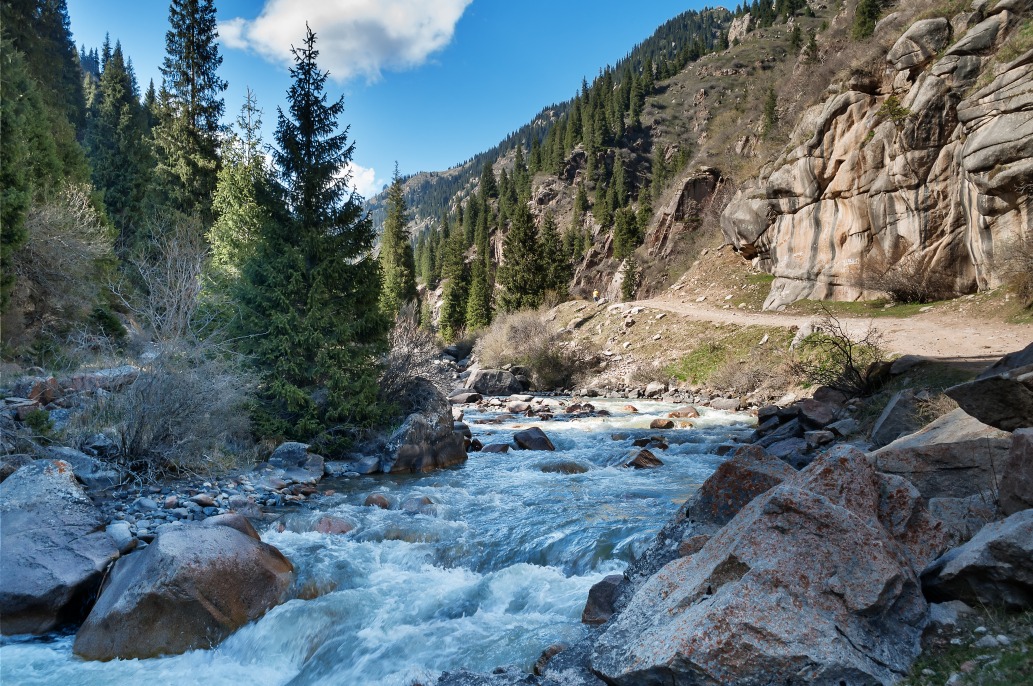
Tash Bashat
Tash Bashat is a natural and sacred site in the mountains near Osh, in southern Kyrgyzstan. Engraved rocks, votive ribbons and local pilgrims compose an off-the-beaten-path destination, where nature meets Kyrgyz spirituality.
Tash Bashat is a natural and sacred site located in the mountains near Osh, in southern Kyrgyzstan. The place combines a landscape of rocks sculpted by erosion with an ancient spiritual presence, rooted in the tradition of open-air sites revered by Kyrgyz populations. It attracts hikers and local pilgrims alike, far from mainstream tourist circuits.
What to see
The site stands out for its distinctive rock formations, some bearing inscriptions or marks left over centuries. The surrounding mountain vegetation—dry grasses, thorny shrubs, a few isolated trees—contrasts with the mineral rawness of the rocks. Strips of fabric tied to branches or stones signal the votive dimension of the place.
History and context
In Kyrgyz culture, many isolated rocky sites are considered mazars (holy places), associated with protective spirits or ancestral figures. Tash Bashat fits this tradition: the name roughly means "stone head" or "main stone" in Kyrgyz, evoking a central rock around which popular devotion is organized. These practices blend Islam with pre-Islamic animistic beliefs.
Visit highlights
The rocks and their inscriptions
The rocky surfaces preserve engraved traces whose age varies. Some relate to the petroglyph tradition widespread throughout Central Asia; others are more recent. Careful observation reveals the layering of several epochs.
The atmosphere of the sacred site
Local visitors often come as families, bringing offerings and prayers. This presence gives the site a living atmosphere, distinct from frozen ruins. Respecting ongoing rituals without disturbing them is part of the experience.
Etiquette and visiting rules
- Wear modest clothing, particularly if pilgrims are present.
- Do not touch offerings, ribbons or objects left on the rocks.
- Ask permission before photographing people in prayer.
- Avoid loud conversations near areas of devotion.
Photography tips
Low-angle light in early morning or late afternoon accentuates rock textures and relief of inscriptions. Wide shots incorporating the surrounding mountain landscape provide context. Avoid framing people in prayer without their explicit consent.
Location and access
Tash Bashat is found in the surroundings of Osh, Kyrgyzstan's second city and natural starting point for exploring the country's south. Access from Osh requires a vehicle, ideally a 4x4 or a local taxi arranged on site. Local English-speaking agencies based in Osh can arrange transport and provide a guide familiar with the site.
The site is not accessible by regular public transport. Accessibility for people with reduced mobility is limited due to the mountainous terrain.
Nearby attractions
- Takht-e-Suleiman (Throne of Solomon) — sacred rock in the heart of Osh, listed as a UNESCO World Heritage site, a must-see in the region.
- Osh Bazaar — one of Central Asia's largest markets, ideal for discovering local crafts and gastronomy.
- Fergana Valley — fertile agricultural plain extending between Kyrgyzstan, Uzbekistan and Tajikistan, rich in traditional villages.
Frequently asked questions
Spring (April-June) and autumn (September-October) offer pleasant temperatures and colorful vegetation. Summer is hot but manageable; winter makes access difficult due to snow and mountain roads.
A local guide is strongly recommended: they know the access route, can explain the significance of site elements and facilitate exchanges with local inhabitants or pilgrims present.
Yes, the two sites complement each other well in a day dedicated to the sacred places of the Osh region. Plan to start with Tash Bashat in the morning, then head to the Throne of Solomon in the late afternoon.
Photography of the landscape and rocks is generally permitted. However, photographing people in prayer or offerings requires their prior consent, out of respect for the sacred dimension of the place.
Choose modest clothing (shoulders and knees covered) and hiking shoes suited to rocky terrain. A hat is useful in strong heat.
Want to discover this destination?
Our local advisors design your tailor-made trip.