Meeting the Dungans
Meeting the Dungans
Scattered across Central Asia, the welcoming Dungans form an ethnic group with a remarkable cultural identity. They have managed to preserve this authenticity by passing it down from generation to generation.
Scattered across Central Asia, the welcoming Dungans form an ethnic group with a remarkable cultural identity. They have managed to preserve this authenticity by passing it down from generation to generation.
Their origins trace back to the 19th century, during the migration of Chinese Muslims to Kyrgyzstan, Kazakhstan, Russia, and Uzbekistan. Their culture emerges from the convergence of three distinct worlds: China, Russia, and Arabia. Conservative yet open-minded, the Dungans today number around 120,000 across this vast region.
History
Attracted by China, peoples of Arab, Persian, and Tibetan origin settled in the country centuries ago.
The blending of languages, cultures, and religions of the locals and newcomers gave birth to the Hui ethnic group. They were particularly widespread in the Gansu and Ningxia regions.
Between 1862 and 1877, a conflict erupted between the Chinese and a faction of the Hui: the Dungan Revolt. The war caused the loss of several million lives and prompted some Hui to flee to neighboring countries. A significant group was welcomed by Kyrgyzstan.
Culture
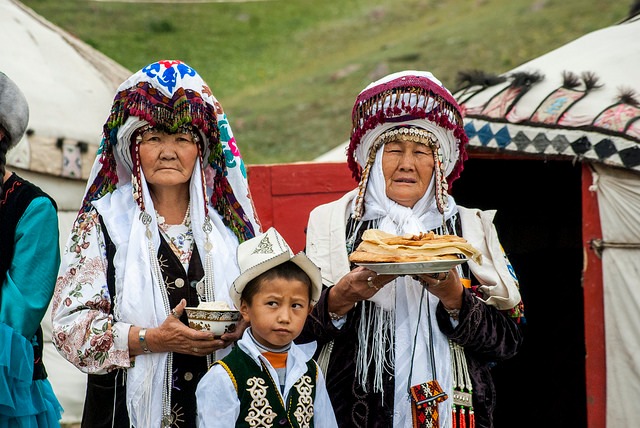
The Dungans take great pride in their culture. At times Chinese, at times Arab, it comprises a distinct language, a unique way of life, and a fascinating array of clothing styles.
The Dungan Language
The Dungan language may seem complex at first glance. When locals speak this dialect, you hear primarily Chinese with the accent of the Shaanxi region. Yet you quickly realize that certain words and expressions are completely foreign even to those fluent in Mandarin. A local guide can offer deeper insights here.
The dialect spoken by the Dungans is actually a curious Mandarin interspersed with Russian, Persian, Arab, and Turkish vocabulary. The locals are indeed polyglots. They are capable of expressing themselves in Russian, Dungan, and the language of the country where they reside.
Their Way of Life
The Dungans love simplicity. A large portion of this ethnic group lives off agriculture, livestock raising, or trade.
Very proud of their identity, they have created and preserved their own ceremonies to celebrate births, circumcisions, marriages, and to cope with mourning. Several museums dedicated to their culture stand in different localities. You can admire traditional musical instruments, traditional clothing, tapestries, and festive ornaments used during various celebrations. Particularly conservative, they favor unions between young people of their own ethnicity.
Walking through town, you'll notice that the locals' clothing style doesn't particularly distinguish itself from ours. Traditional attire is generally worn during cultural or religious events.
The primary religion of the Dungans is Islam. They read the Quran, perform the five canonical prayers, and regularly attend the mosque. They strive to consume neither alcohol, tobacco, nor drugs, and do not resort to exorcism when facing illness.
Dungan Cuisine
When visiting a Dungan locality, you absolutely must taste Lamian. These noodles are part of several centuries of cultural heritage. Don't forget either Sanzi or the delicious Lagman.
Where to Meet the Dungans?
Immersing yourself in Dungan culture in major cities is not particularly straightforward. To discover their traditions, it's better to visit villages where they are perfectly reflected.
If you're traveling in Kyrgyzstan, head toward the village of Yrdyk near Karakol, Sokoluk, or Milyanfan.
If you're exploring Kazakhstan, visit Masanchi or Sortobe instead.
Some communities also exist in Uzbekistan, Russia, Ukraine, and Tajikistan.
Give it a go!
Our local experts arrange this activity for you.