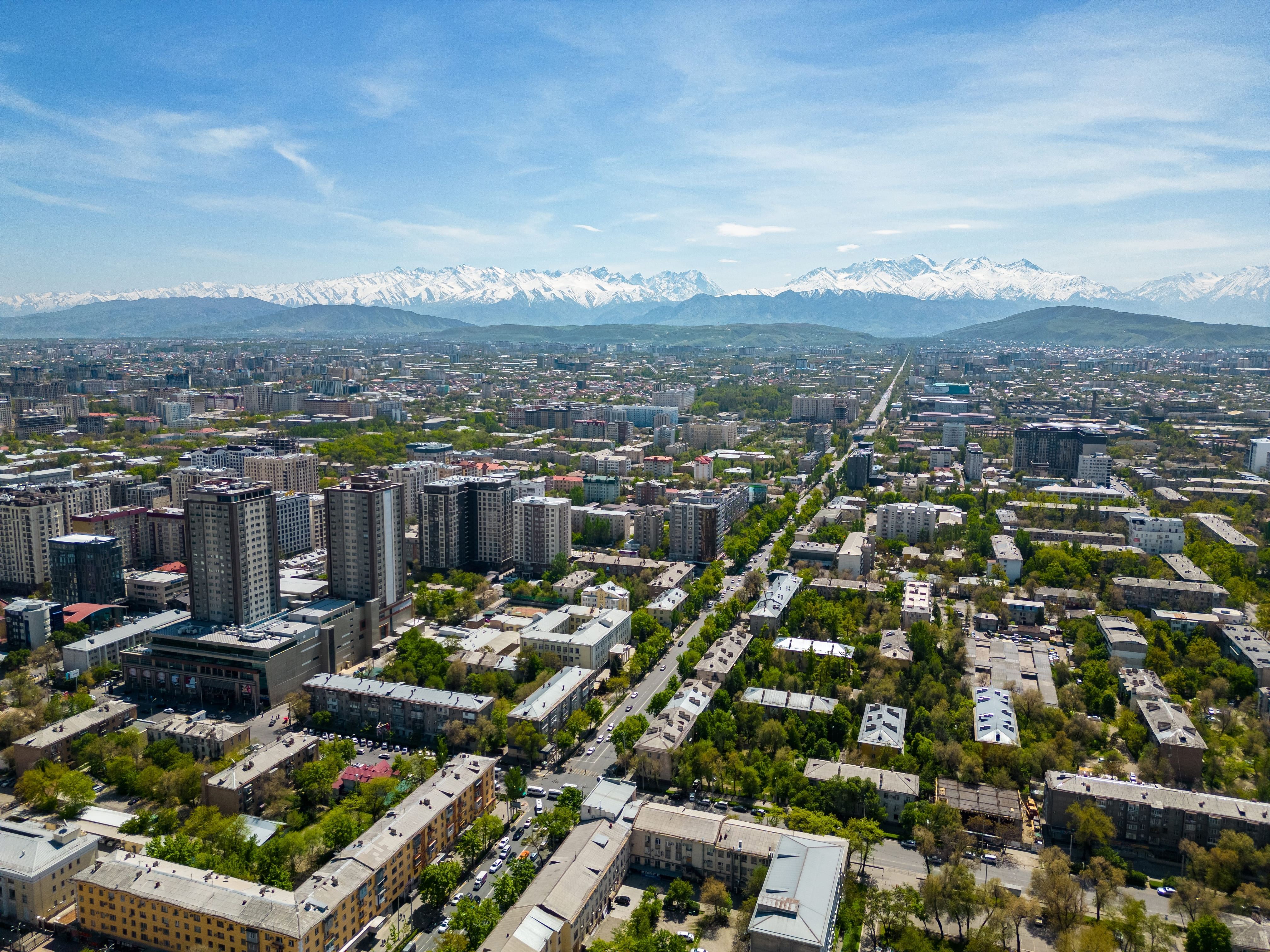
Song-Köl and Naryn
A high-altitude lake plateau at 3,016 metres inhabited in summer by transhumant herders, extending southward to Naryn and the Tash Rabat caravanserai on the Silk Road.
Song-Köl and Naryn form the remote heartland of Kyrgyzstan, a highland zone where summer steppe grasslands replace the verdant northern valleys and where population density drops below 6 people per square kilometre. Our local agency, based in Bishkek, treats this region as a cohesive block: you ascend by road from Kochkor or Bishkek, and typically descend toward central Tian Shan or south via the M41 toward Osh. Plan 7 to 9 hours of driving from the capital to reach the first yurt camps by the lake, via the Kalmak-Ashu Pass (3,446 m) or Moldo-Ashu Pass (3,346 m), both closed by snow from November through May.
Song-Köl lake itself is a high-altitude plateau covering 270 km² at 3,016 metres, treeless and without permanent settlements. From mid-June through late September, about a hundred herding families bring their horses, sheep and yaks to these pastures for summer transhumance, the jailoo. This is one of the last regions of the country where this pastoral cycle persists as a genuine economic livelihood, not as folkloric recreation. The yurts are fully functional, fermented milk (kumiss) is consumed daily, and children ride out at dusk to herd livestock back to camp. Our hosts often belong to clans from the Kyzart and Aral valleys, who have maintained seasonal use of these traditional pastures.
Further south, the town of Naryn (38,000 inhabitants, at 2,000 m altitude) stretches for 15 kilometres along the Naryn River in a deep valley with rust-ochre slopes. It serves as the administrative hub of the country's largest and most sparsely populated province. Naryn functions as a logistics base: a night in a hotel, banks, fuel, and departure toward Tash Rabat. This 15th-century stone caravanserai, nestled in a valley at 3,200 metres 110 km southwest of town, marked a stopping point on the southern branch of the Silk Road between Kashgar and the Fergana Valley. Today it stands as Kyrgyzstan's only intact medieval edifice.
Beyond Tash Rabat, the track leads to Torugart Pass (3,752 m), a border checkpoint with China still active for freight. We do not arrange passenger crossings (complex procedures, mandatory prior authorization), but approaching the pass itself—with its glacial lakes and yak herds—merits a full day's excursion from Tash Rabat. Wildlife in the region includes Menzbier's marmots, golden eagles and, more elusive, Siberian ibex on the northern ridges of Naryn-Too.
Nomadic culture here is less staged than around Issyk-Köl. Equestrian displays (kok-boru, oodarych, tyiyn enmei) form part of daily life for herding families, and our partners organize them on request without spectacle pricing. Cuisine centres on beshbarmak (flat noodles with mutton), kuurdak (sautéed meat and onions) and, more rarely, chuchuk, dried horse-meat sausage. Bread (lepyoshka) is baked in the tandoor of a neighbouring yurt.
What to discover
Night in a yurt on Song-Köl's shore. Sunset over water at 3,016 metres, shared dinner with the herding family, and black tea with milk served from 6 am before the herds depart.
Tash Rabat caravanserai. Thirty-one vaulted stone cells, a waypoint on the southern Silk Road, isolated in a valley at 3,200 metres and accessible by a 15 km track from the M41.
Crossing Kalmak-Ashu Pass. Switchback climb to 3,446 metres with sweeping views down to the Song-Köl plateau, the threshold between Kochkor's agricultural valley and the summer steppe.
Equestrian display on the jailoo. Kok-boru, mounted struggle for a goat carcass, organized by the herders themselves on their summer pastures, without grandstands or ticketing.
Approach to Torugart Pass. Track toward the Chinese border at 3,752 metres, yak herds, small glacial lakes and the distant silhouette of the eastern Tian Shan ranges.
When to visit
The practical window for Song-Köl is narrow: mid-June through late September. Before June 15, access tracks remain snow-bound on the passes and herding families have not yet moved up. After September 25, yurts are struck and herds descend to winter villages in Kochkor and Aral. In peak summer (July-August), daytime temperatures at the lake reach 22–25°C, but nights drop to 4–6°C, and afternoon hailstorms remain possible. Pack a sleeping bag rated to -5°C as standard practice; yurts are only heated by stove on request.
Naryn and Tash Rabat are accessible more broadly from April through October, though Tash Rabat at 3,200 metres remains cold until late May and from early October onward (frequent night frost). The best Song-Köl + Naryn + Tash Rabat combination falls between June 25 and September 15. Avoid the final week of August if seeking solitude: it marks peak European visitor season on the most popular jailoos along the northern shore.
Practical advice
Allow 4 to 5 days for the Song-Köl + Naryn + Tash Rabat combination from Bishkek, including driving time (7 hours to reach the lake, 4 hours onward to Naryn, 3 hours round-trip to Tash Rabat). With fewer than 3 days, the experience becomes a tiring transit punctuated by a single yurt night. The logistics gateway is Manas Airport in Bishkek, then 4x4 transport (essential for lake access tracks). No operational regional airport serves passenger travel in this sector.
The region combines logically with central Tian Shan (Jyrgalan or Karakol valleys) descending northward, or with Osh and the South via the M41 and a roundabout approach via Kazarman valley (demanding track, open June to September only). A 12–14 day loop via Issyk-Köl works well. Comfort is intentionally simple: shared yurts sleeping 4–6 at the lake, pit toilets outside, solar showers or none depending on camp. This region suits contemplative travellers, riders, self-sufficient trekkers and families with children 8 and older. It is less suited for those seeking hotel-standard lodging or stable internet connection.