Where to See Petroglyphs in Kyrgyzstan?
While Kyrgyzstan draws visitors with its endless mountains and nomadic culture, the country is equally a perfect destination for history enthusiasts.
While Kyrgyzstan draws visitors with its endless mountains and nomadic culture, the country is equally a perfect destination for history enthusiasts. Step back in time along the Silk Road and at the crossroads of great empires, dive into Issyk Kul in search of a submerged city, pass through Soviet history in the Barskoon valley, trace the remnants of a vanished ocean and its fossils... The Kyrgyz territory has been crossed by centuries of history, perhaps one of the most fascinating and mysterious in the world, as there remains much yet to discover.
Among the historical treasures to uncover during a journey through Kyrgyzstan, you'll find thousands of ancient petroglyphs, these rock carvings bearing witness to forgotten civilizations…
A brief history
Kyrgyz petroglyphs have been studied by the historical and scientific community for over 200 years, and yet many mysteries remain unsolved. Thousands can be found across different regions of Kyrgyzstan, in significantly remote areas, suggesting that Kyrgyz territory was populated very early in history.
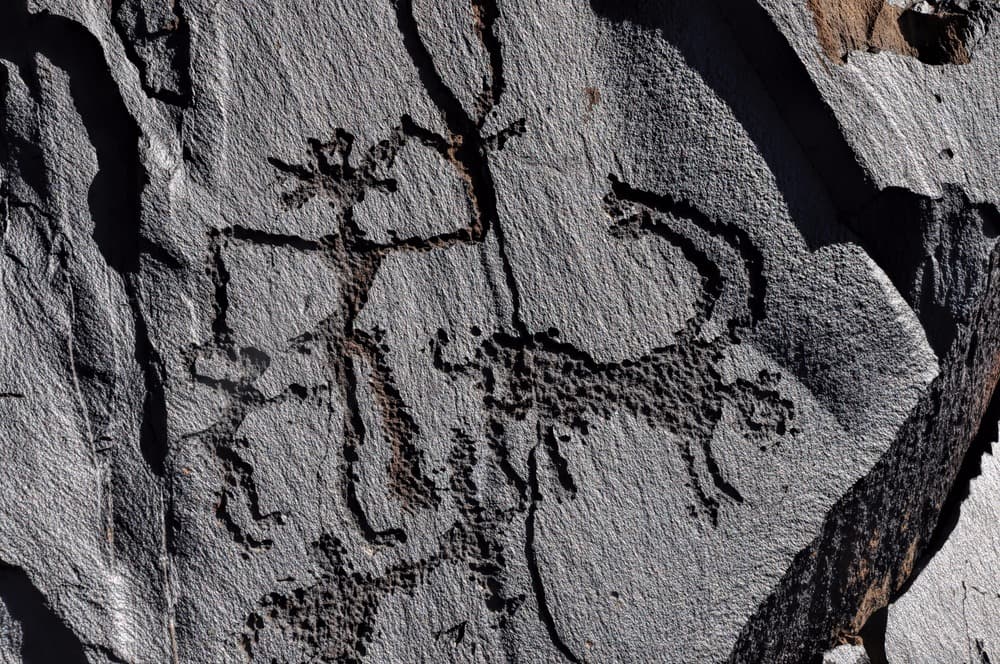
Petroglyphs are rock carvings engraved on basalt or volcanic stones. These rocks have the distinctive feature of being black on their surface, and it is generally on this dark part that ancient drawings are found.
The earliest petroglyphs date back to the Bronze Age, in the 3rd century before our era, while the most recent ones date to the 8th century. These dates remain disputed, with some scholars arguing that the first petroglyphs appeared 7,000 or 8,000 years ago. While carving techniques and drawing styles evolved over time, the majority represent hunting scenes.
The drawings bear witness to the lives of these ancient peoples: the domestication of animals, traditional dances, hunting, warfare, tribal demarcation, conflicts, technical innovations... They prominently feature numerous animals, including the Marco Polo sheep, snow leopards, birds, horses, yaks, camels, goats... and certain demonic creatures, perhaps stemming from their beliefs. These motifs have been incorporated into many Kyrgyz ornaments, found for instance today in traditional carpets, the shyrdak.
There are essentially two distinct drawing styles. The oldest is more primitive, featuring simple geometric forms. With the advent of metalworking, artists evolved toward rounded drawings, more complex and representative of reality.
Petroglyph sites were sacred, holy places of worship, including for peoples who came after the carvings were made.
Petroglyph sites
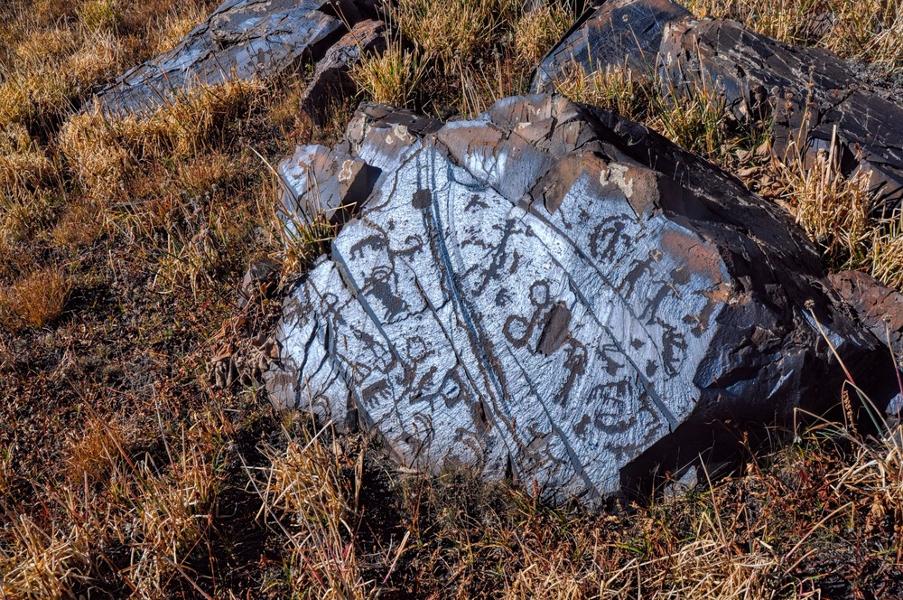
Note: it's best to visit these sites in the morning or late afternoon, away from strong sunlight. When the sun is intense, the carvings are far less visible and you'll miss the majority of them.
Saimaluu Tash
Difficult to access, the Saimaluu Tash site in southern Kyrgyzstan, nestled at 3,000 meters altitude, is the premier destination to discover the complex history of petroglyphs. Some 90,000 carvings are hidden within untouched forest, showcasing works spanning more than 10 different millennia. Here you can witness the greatest diversity of styles and drawings.
The site's name translates from Kyrgyz as "the embroidered stone", referring to the thousands of engraved rocks it harbors. From the village of Kazarman, you must reach it on foot or horseback.
This ancient sanctuary remained protected from vandalism and construction precisely because of its sacred character. Even as peoples changed, Saimaluu Tash remained an important place of worship. As locals recount in stories passed down through generations, travelers traditionally brought offerings to the gods at Saimaluu Tash, and those who failed to do so were cursed...
Cholpon-Ata
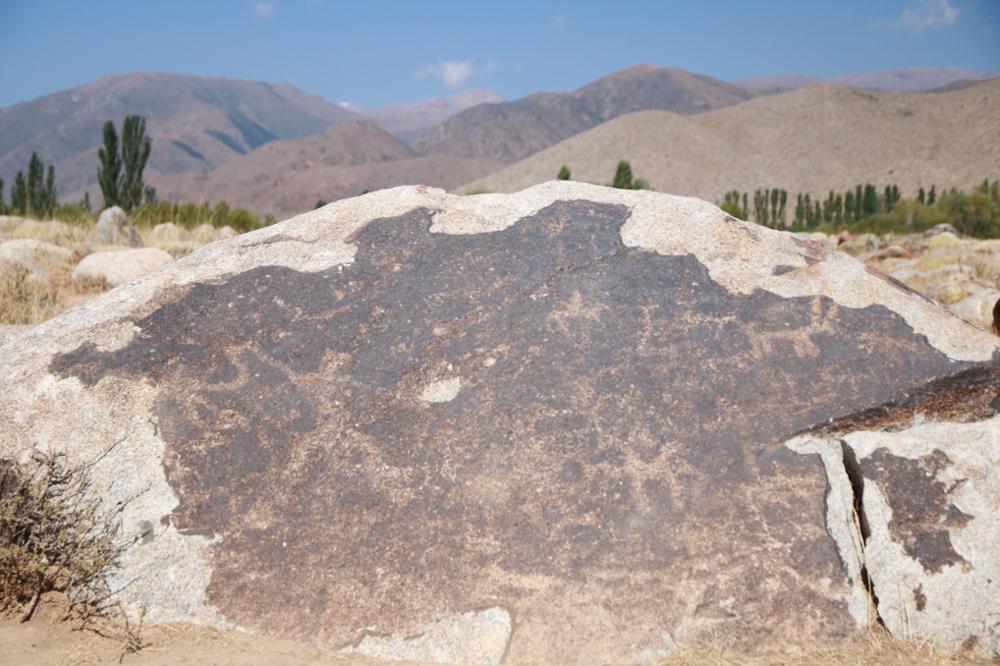
On the northern shore of Lake Issyk Kul sits the second-largest petroglyph site in Kyrgyzstan. More accessible, it lies just a few kilometers north of the town center of Cholpon-Ata, near the former airport of the resort.
This open-air museum, also called the stone garden, spans 42 hectares. The carvings date from the 2nd century before our era through the 4th century. They primarily represent animals and hunting scenes, the most renowned and distinctive being snow leopards engaged in hunts. There are also numerous depictions of deer, possibly connected with the Kyrgyz Bugu tribe ("red deer").
Other interesting formations left by these ancient peoples can be found on this territory: graves, bal-bal (warrior monuments), tribal boundaries, shamanic circles...
Sulaiman Too
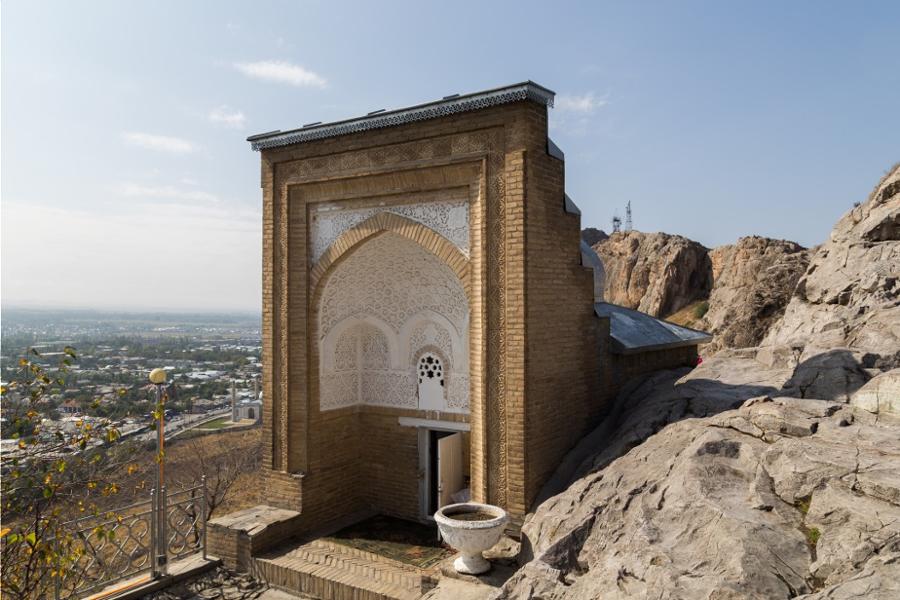
The southern capital, Osh, is dominated by the sacred mountain of Sulaiman Too. An important pilgrimage destination throughout history, designated as a UNESCO World Heritage site, Sulaiman Too also harbors around a hundred petroglyphs. The carvings are concealed within sacred caves.
Other sites
You may also encounter petroglyphs in other places worth visiting in Kyrgyzstan. The magnificent Son Kul Lake, a nomadic grazing ground, shelters a few carvings, evidence of ancient peoples on this territory. South of Bishkek, the Chunkurchak Valley has several dozen carvings left in their original positions, just below the panorama overlooking the Kyrgyz capital. The petroglyphs at the historic Burana complex were relocated following archaeological excavations in the region.
Many sites have yet to be discovered, and it's entirely possible to stumble upon petroglyphs during your hikes through Kyrgyzstan...
Frequently asked questions
Petroglyphs are ideally visited early in the morning or late in the afternoon to avoid direct sunlight, which makes the carvings less visible.
Prices vary depending on the sites. Cholpon-Ata has a paid open-air museum, while certain sites like Saimaluu Tash require a guide.
A guide is strongly recommended, especially for Saimaluu Tash which is difficult to access, and to understand the historical significance of the carvings.