The Kyrgyz Currency

The Kyrgyz Currency

The Kyrgyz Currency

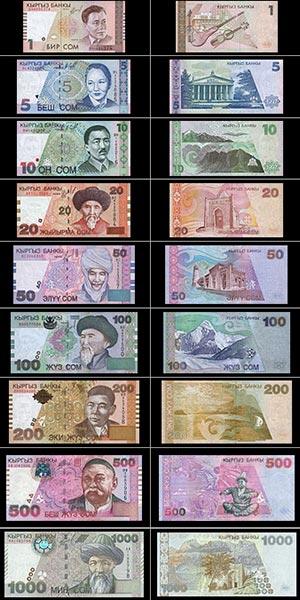
The currency you will use in Kyrgyzstan is the Som, which comes in both banknote and coin form. You will find banknotes in denominations of 1, 5, 10, 20, 50, 100, 200, 500, 1000, and 5000, as well as coins of 1, 3, 5, 10, and 50. The banknotes have the distinctive feature of displaying the faces of Kyrgyz artists and notable figures.
The Kyrgyz Currency
  • The 1 banknote depicts Abdylas Maldybaev, a former composer, actor, and singer.
  • The 5 banknote features Bubusara Beyshenalieva, Kyrgyzstan's first prima ballerina.
  • The 10 banknote showcases Kasym Tynystanov, a poet, scientist, and politician.
  • The 20 banknote represents Togolok Moldo, a poet, orator, and composer of folk songs.
  • The 50 banknote displays Kurmanjan Datka, known by the epithet Queen of the South, a celebrated stateswoman.
  • The 100 banknote bears the face of Toktogul Satylganov, the most renowned of Kyrgyz poets and improvising singers.
  • The 200 banknote features the portrait of Alykul Osmonov, a poet who modernized poetry in the country.
  • The 500 banknote represents Alykul Osmonov, a great poet and orator.
  • The 1000 banknote displays the face of Yusuf Khass Hajib, who was a poet, statesman, vizier, and philosopher.
  • The 5000 banknote reveals the visage of Suimenkul Chokmorov, a great Kyrgyz actor.

Currency

The Som is the monetary unit of Kyrgyzstan, in use since the country's independence from the Soviet Union in 1991. Its ISO 4217 code is KGS.

Exchange Rates

As of December 16, 2016: 72.06 Som (KGS) = 1 Euro or 1.04 Dollar 100 Som (KGS) = 1.39 Euro or 1.45 Dollar The cost of living in Kyrgyzstan is lower than in many Western European countries. In 2016, the cost of living in Kyrgyzstan was on average 56% less expensive than in France. You can exchange your money—euros, dollars, British pounds, and other currencies—at numerous exchange offices throughout the country. However, despite their prevalence, exchange offices often have difficulty exchanging notes smaller than 50 euros. Banknotes of 10 and 20 euros are typically exchanged at a rate at least 20% below the official rate. If you are tempted to exchange money on the black market, be aware that this offers no financial advantage. Moreover, scams are prevalent in such places. It is therefore strongly advised against pursuing this option.

Payment

In Kyrgyzstan, ATMs are found only in a few cities such as Bishkek, Osh, Talas, and Karakol. Credit cards will therefore be useful in these locations. However, outside these areas, only luxury hotels and a few bars or restaurants accept credit card payments. Banks typically open from 9:30 am to 5:30 pm. Plan ahead before heading out on the road. Save

Photos

Your travel project

Get ready to go

Visa, vaccinations, insurance, packing… everything for a worry-free departure.

My checklist

Ready for the adventure?

Let our local advisors design your tailor-made trip.