Lenin Peak
Lenin Peak
The third giant of Kirghizistan at 7134 m, Lenin Peak draws climbers and trekkers to the heart of the Pamir from Osh and the Alai Valley.
Lenin Peak is one of the three giants of Kirghizistan. Higher than Khan Tengri Peak (7010m), it remains lower than Pik Pobeda, or Jengish Chokosu (7439m). While these two summits stand in the east of the country, on the Chinese border in the Tian Shan, Lenin Peak rises to 7134m in southern Kirghizistan, in the Pamir mountain range, on the border with Tajikistan.
Heading toward this summit, which has earned a reputation as the most accessible of the 7000m peaks.
A Touch of History
It was in 1871 that this summit was first spotted by Russian explorer Alexei Fedchenko. He described it as a peak that "always appeared higher than the others, no matter the distance. The summit was always shrouded in clouds, but its shape was easy to make out. It had a pyramidal form… Not a trace of black was visible. The mountain in its entirety was blanketed in snow."
From that moment, Lenin Peak, then named Kaufman Peak, was considered the highest summit of the Russian Empire, and later of Soviet space. It wasn't until 1933 that it lost this status to Communism Peak (now called Ismail Samali Peak, formerly Stalin Peak), which rises to 7495m in Tajikistan.
Alpinists reached its summit for the first time on September 25, 1928. It was a German-Austrian team from the USSR, sent to explore the Pamir mountain range. During this expedition, they gave what they believed to be the highest summit of the USSR the name Lenin.
Three German climbers claimed to have reached the summit: Allwein, Winn, and Snider. Upon descent, they were hospitalized due to severe frostbite. However, their account is sometimes disputed, as they took no photographs or left any trace at the summit.
Other expeditions ended in failure. In 1933, Krylenko turned back 280m from the summit due to weather. However, he discovered on descent the northern route, from the Alai Valley, which proved far more accessible. It wasn't until 1934 that a second Soviet team succeeded in reaching this giant: on September 8, they summited via the northern route and erected a bust of Lenin.
Followed more expeditions, the establishment of the first camps, the construction of a road leading to base camp, and later the use of helicopters and aircraft to transport equipment. Since then, Lenin Peak has become one of the most coveted summits in the world.
Like any mountain of this magnitude, Lenin Peak has unfortunately witnessed some tragic events. In 1974, 8 members of a Soviet women's team were caught in a storm and lost their lives. Other climbers stationed just 200m away were unable to reach and rescue them.
Yet Lenin Peak holds the worst disaster in mountaineering history: on July 13, 1990, an earthquake triggered a terrible avalanche onto the second camp (5300m) during the night. Of the 45 climbers sleeping there, 43 perished. Despite rescue efforts, only one body was recovered.
Discovering Lenin Peak Today
Lenin Peak is one of the world's most coveted summits and attracts hundreds of climbers from around the globe each year. It is considered the most accessible of the 7000m peaks, meaning the least technical. This does not, however, mean it is easy, as the summit is known for capricious weather and avalanche risk. In any case, climbing a 7000m peak is never a task for beginners. It demands excellent physical fitness and thorough acclimatization.
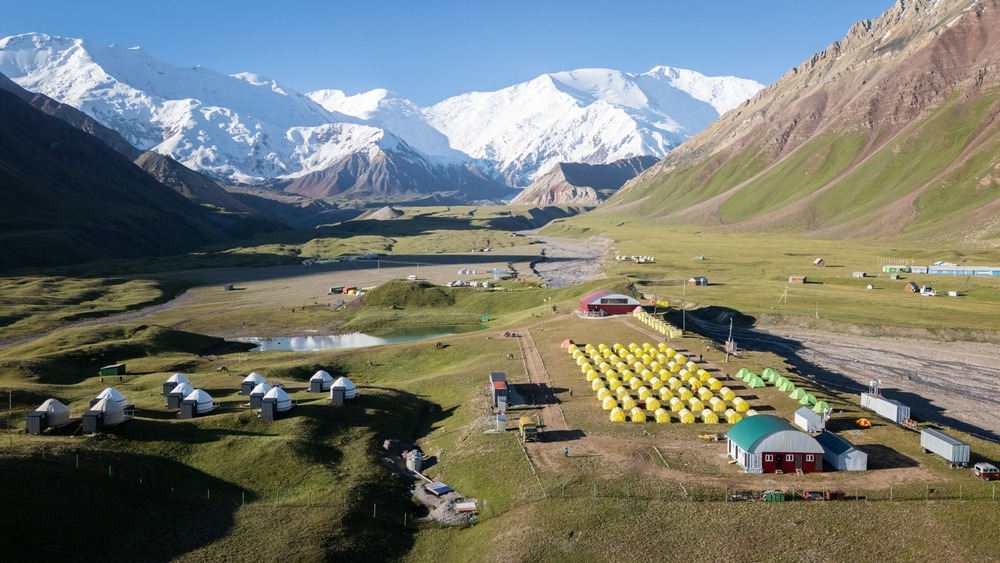
From the city of Osh, in southern Kirghizistan, a road leads to the Lenin Peak base camp (3600m) in roughly 7 hours. This means the magnificent view of this snow pyramid is accessible to everyone, even children! From base camp, you can undertake short treks to explore the surroundings, or attempt lower summits, such as Razdelnaya Peak. Of course, given the camp's altitude and road access, it is strongly recommended to spend a few days acclimatizing beforehand—for instance, in Ala Archa National Park near Bishkek.
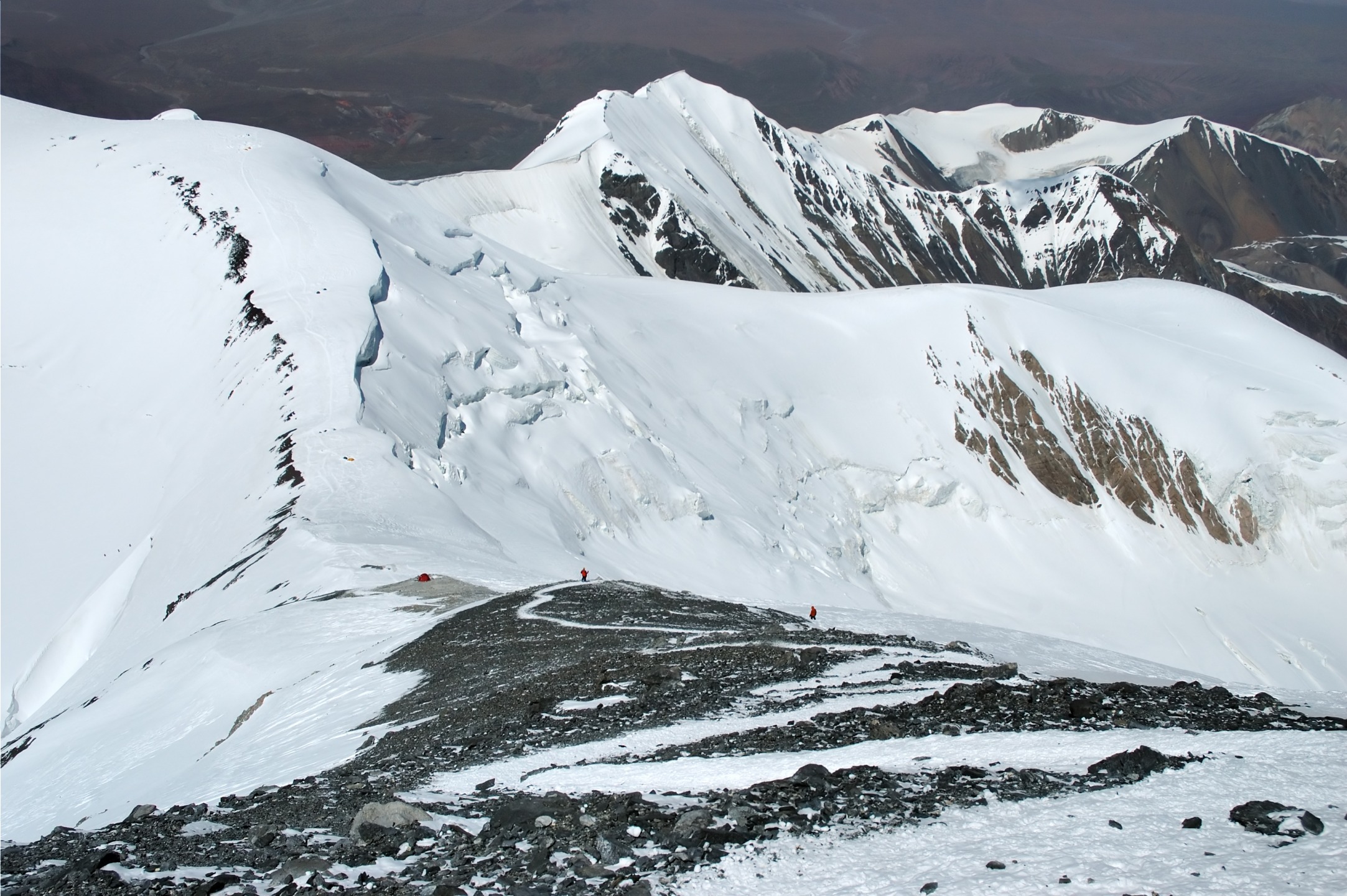
16 routes lead to Lenin Peak's summit. The most popular comprises 4 camps in total and passes through Razdelnaya Summit (6148m). Plan for at least three weeks for the ascent, undertaken in stages for proper acclimatization. Though the Lenin bust no longer stands at the summit, you will find other relics from past expeditions, such as an aircraft that was forced to land at 5200m in 1937 and never managed to take off again.
Lenin Peak is part of the Snow Leopard Trophy, awarded to climbers who scale all five 7000m summits in the former Soviet space: Communism Peak (7495m), Pik Pobeda (7439m), Lenin Peak (7134m), Korjenevskoi Peak (7105m), and Khan Tengri Peak (7010m).
Practical Information
The best season for a Lenin Peak ascent is between mid-June and mid-August. Outside these dates, the climb becomes extremely difficult and dangerous, and camps are dismantled.
You will need a border permit to reach Lenin Peak or its base camp: arrange this in advance through a tourism agency.
You can hire a guide and porters for your expedition.
Accommodation in Lenin Peak
Also discover
Want to discover this destination?
Our local advisors design your tailor-made trip.