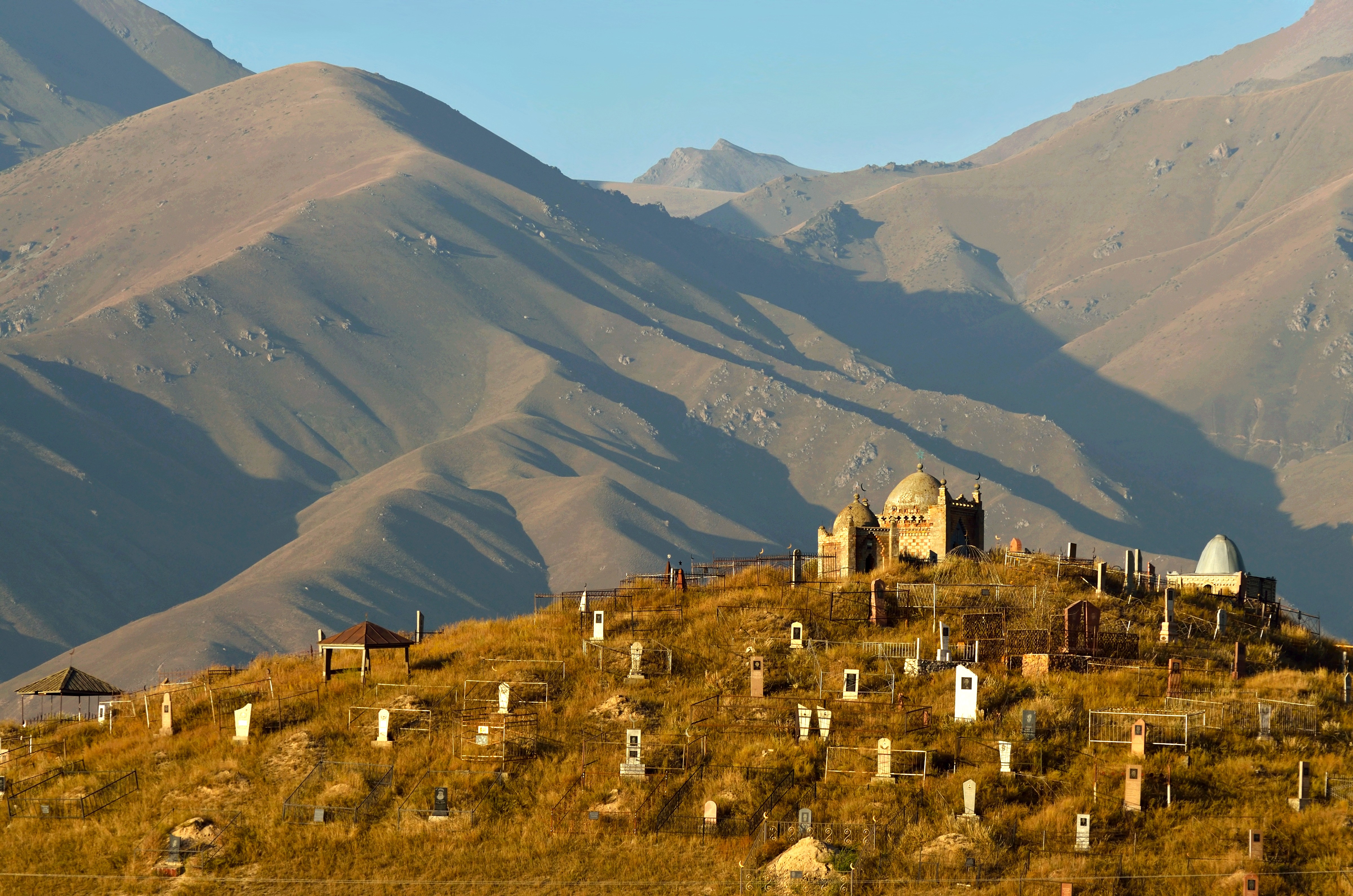
Bishkek Region
A crossroads capital at the foot of the Kyrgyz Ala-Too range, Bishkek serves as a logistical base and offers, an hour to the south, the glacial valley of Ala-Archa for acclimatization.
Bishkek is a flat city, situated at 800 meters altitude on the northern foothills of the Kyrgyz Ala-Too range, whose snow-capped peaks stand out sharply to the south on clear days. Founded in 1878 around a Kokandi caravanserai and redesigned during the Soviet era under the name Frunze, it has retained a grid layout, avenues lined with poplars, and a network of aryches—small irrigation canals running alongside the sidewalks. The city has just over one million inhabitants and remains human in scale: you can cross the center on foot in thirty minutes, from Ala-Too Square to Panfilov Park.
Above all, it is a crossroads city. The Osh Bazaar, in the western quarter, concentrates arrivals from the south and the Chu Valley: dried apricots from Batken, honey from Toktogoul, kourout pellets, and chyrdak felt carpets. A few streets away, Dordoi Bazaar, one of Central Asia's largest wholesale markets, draws Kazakh, Uzbek, and Chinese merchants. This hub function explains why Bishkek remains cosmopolitan: Kyrgyz in the majority, but also Russians, Dungans, Uyghurs, and Koreans descended from Stalin-era deportees. The Dungan canteens downtown serve ashlyam-fou with fresh noodles and black vinegar, a dish found nowhere else in the country.
As for heritage, the offering is modest, and we'll be frank about it: you don't come to Bishkek for museums alone. The National History Museum, reopened in 2021 after extensive renovation, showcases balbals—Turkish funerary stelae from the 6th to 10th centuries—and fine collections of nomadic metalwork. The National Gallery of Fine Arts preserves some interesting pieces of Kyrgyz socialist realism. The Holy Resurrection Orthodox Cathedral and the Central Mosque, completed in 2018 with Turkish funding, bear witness to the city's ordinary religious coexistence.
The true draw of the region lies in its southern exit. Some 40 kilometers from the center, Ala-Archa National Park stretches along a glacial valley between 1,600 and 4,895 meters at Semionov-Tian-Shansky Peak. The road climbs there in an hour from Bishkek. We systematically send our travelers here early in their stay for an acclimatization hike: the loop to Ak-Say Waterfall (5-6 hours round trip, 800 meters elevation gain) or, for more experienced hikers, the ascent to Ratsek Refuge at 3,300 meters. It's also a classic alpinism base for cordées aiming at Korona Peak or Free Korea.
Further east in the same Chu Valley, the Burana site preserves a truncated 11th-century minaret, the last vestige of the Kharakhanid city of Balasagoun, an ancient capital on the Silk Road. The field of balbals surrounding it can be visited in a half-day from Bishkek, often combined with Konorchek Canyon and its red clay formations. To the southwest, the Issyk-Ata thermal springs and Cholpon-Ata petroglyphs, further along the lake, complete the network of day excursions our team adjusts according to your available time.
Practically speaking, Bishkek concentrates everything a Kyrgyzstan trip needs: Manas International Airport, 30 minutes from the center; the western bus station for marshrutkas to Osh or Karakol; 4x4 rental agencies; well-stocked supermarkets for trekking provisions. This is where we conduct security briefings, verify pass conditions (Töö-Ashuu, Kaldama, Kegety open and close depending on snow) and coordinate drivers.
What to Discover
Acclimatization hike at Ala-Archa. Ascent to Ak-Say Waterfall via the right-bank trail, through Tian Shan spruce forests with views of the suspended glaciers of the Adyghené massif. Return in the evening to Bishkek for dinner at a restaurant.
Osh Bazaar in the morning. Stalls of spices, dried fruits, and dried meat open around 7 a.m. Our team will accompany you to taste samsa with onion fresh from the tandoor and identify varieties of kourout.
Burana minaret and the Chu steppes. A Kharakhanid relic from the 11th century, 80 kilometers east of Bishkek, surrounded by an alignment of Turkish funerary stelae. A half-day excursion, often extended to Konorchek Canyon.
Dungan cuisine downtown. Hand-pulled ashlyam-fou and lagman from the canteens on Gorky Street, a legacy of Chinese Muslims settled here since the 1880s. A culinary point found only in Bishkek and Karakol.
The renovated National History Museum. Collections of balbals, silver nomadic trappings, and a reconstruction of a ceremonial yurt. Allow 1.5 hours to grasp the essentials before heading into the mountains.
When to Go
Bishkek experiences a marked continental climate. Summers are hot and dry: between June and August, daytime temperatures range from 30 to 35 °C in the city, peaking at 38 °C in July. This is paradoxically peak tourist season because high-altitude passes are then passable, but we advise scheduling Bishkek in early morning or late afternoon and ascending to Ala-Archa where it's 8 to 10 °C cooler. Shoulder seasons, from mid-May to mid-June and from early September to mid-October, offer a better compromise: 22 to 28 °C in the city, clearer skies on the range, orchards in bloom in spring or golden poplars in autumn.
In winter, from December to February, it's cold: averages of -4 °C, night freezes at -15 °C, and smog that sometimes settles in the basin due to coal heating. March and April are rainy, muddy transition months, unfavorable for mountain excursions as Ala-Archa trails remain snow-covered above 2,500 meters until May. For a trip combining Bishkek and mountain regions, the mid-June to mid-September window remains most reliable.
Practical Tips
We recommend devoting 1 to 2 nights to Bishkek at the start of your journey and possibly 1 night at the end before your return flight. A full day suffices for the center, bazaars, and museum; a second allows for an excursion to Ala-Archa or Burana. Beyond that, interest wanes: Bishkek is a logistical base, not a destination in itself. Manas Airport, 25 kilometers northwest, receives flights from Istanbul, Moscow, Dubai, and some seasonal direct connections from Frankfurt or London.
The region naturally combines with all other destinations in the country. The northeast road leads in 4 hours to Lake Issyk-Kul, the classic circuit starting point. The southern road, via Töö-Ashuu Pass (3,586 m), descends to Song-Köl and Naryn in 6 to 8 hours. Central Tian Shan is reached from Karakol via a loop around Issyk-Kul. Osh and the south are reached either by a one-hour domestic flight from Manas or via the legendary Bishkek-Osh road, 12 hours of passes and gorges. For accommodations, Bishkek offers international hotels, family guesthouses, and apartments; we work with intimate establishments. The city suits all profiles, including families with children, and remains safe to walk during day and evening in the center.