Uzgen
Uzgen
A former capital of the Karakhanids on the Silk Road, Uzgen preserves an 11th-century minaret, three mausoleums, and a typical Fergana Valley bazaar.
Located in southern Kyrgyzstan, at the edge of the Fergana Valley and an hour's drive from Osh, Uzgen ranks among the country's oldest cities. A former capital of the Karakhanids and a trading post on the Silk Road, it preserves a remarkable architectural complex and a distinctly Uzbek character that sets it apart from the rest of Kyrgyzstan.
Why stop in Uzgen
Uzgen offers a historical and cultural pause within a Kyrgyz itinerary often dominated by mountain landscapes. The city brings together in a few streets a renovated minaret, three Karakhanid mausoleums, a madrasa and a mosque, surrounding a lively bazaar where local red rice is sold. Its population over 90% of Uzbek origin gives the city an atmosphere closer to Bukhara or Samarkand than to Bishkek. Plan half a day to a full day to explore it.
History of a Silk Road city
The earliest traces of civilization in Uzgen date back to the 2nd century BC. The city, then known as Maravannahr, occupied a strategic position on the route connecting the Fergana Valley to Kashgar in China, and served as a supply point for caravans.
Its heyday corresponds to the period when it became capital of the Turkish Karakhanid empire, from the 10th to the 13th century. The city was then so densely built that, according to local tradition, you could cross it from rooftop to rooftop without setting foot on the ground. It is during this period that the monuments still visible today were erected.
The Mongol invasion led by Genghis Khan in the 13th century severely damaged the city. A major earthquake in the 20th century further damaged several buildings, but the heart of the historical complex survived and has undergone restoration.
What to see in Uzgen
The Karakhanid complex
The main site includes:
- a madrasa and a mosque;
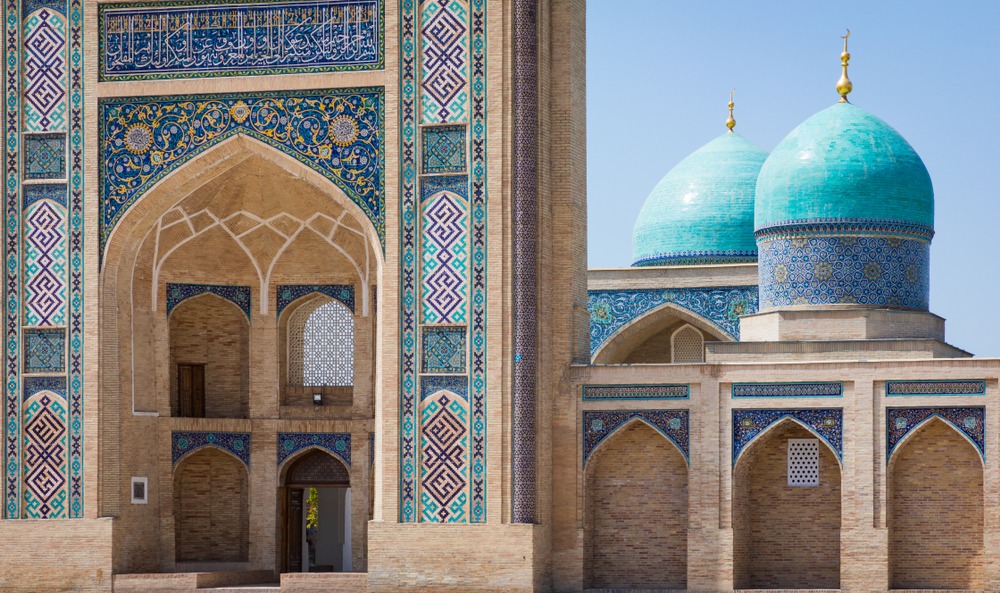
- the three mausoleums of members of the Karakhanid dynasty, adorned with decorative carved baked brick characteristic of medieval Turco-Persian art;
- the Uzgen minaret, which originally reached 44 meters and now stands 20 meters tall after various collapses. Recently renovated, it can be climbed via a narrow, dark interior staircase to a cupola offering panoramic views over the valley, rice paddies, and the foothills of the Pamir.
Excavations at the site have uncovered coins, gold and silver objects, vases, and ceramics testifying to the city's commercial activity.
The bazaar and Uzgen rice
The central bazaar is one of the liveliest in the region. You'll find fruits, spices, textiles, and especially Uzgen red rice, a variety renowned throughout Central Asia, traditionally used to cook plov. The region largely lives from its agricultural production, and it's possible to visit a local rice mill through a guide or agency.
The historic public bath
On Lenin Street, near the museum, a Karakhanid-era hammam is still active. It's one of the rare historic public baths in the region still open, and an experience in itself for those wishing to extend their visit to the complex.
Practical information
The historical complex can be visited in 1 to 2 hours. Entrance to the site and the public bath remain at very modest prices (a few dozen soms). Hours vary by season, with wider opening times in summer than in winter; inquire on the day itself from your guide or accommodation. The bazaar operates during the day every day.
To visit a rice mill, arrange an appointment through your local agency.
When to go
The Fergana Valley has a dry continental climate, warmer than Kyrgyzstan's mountainous regions. The best times to visit are from April to June and September to October, when temperatures are comfortable and rice paddies are active. Summer can be very hot (often above 35°C), winter cold but dry.
How to get there
Uzgen is located 55 km northeast of Osh, about 1 hour's drive, and 615 km from Bishkek, roughly 10 hours by the north-south road crossing the country. Most travelers combine the stop with a journey between Osh and Jalal-Abad or Arslanbob.
Three main options:
- Marshrutka (shared minibus) from Osh, frequent and economical;
- Shared taxi, faster;
- Private car or with driver, ideal for combining with the nearby Kara-Choro National Park.
From Bishkek, a domestic flight to Osh allows you to avoid the long drive across the passes.
Nearby attractions
- Osh (55 km): the country's second city, famous for its sacred mountain Sulaiman-Too.
- Jalal-Abad: thermal city about 1.5 hours' drive north.
- Arslanbob: the world's largest walnut forest, about 3 hours' drive away.
- Kara-Choro National Park: just east of Uzgen, ideal for mountain hiking.
To further explore Karakhanid heritage, the Burana minaret, in the Chuy Valley in the country's north, serves as the northern counterpart to Uzgen's.
Frequently asked questions
Frequently asked questions
Half a day is enough for the Karakhanid complex, bazaar, and a visit to the public bath. Allow a full day if you want to add a rice mill visit or an excursion to Kara-Choro park.
No. Uzgen is in Kyrgyz territory and can be visited freely. The Uzbek border is nearby but does not run through the city. No special formalities are required to visit from Osh or Bishkek.
Uzbek is dominant, Kyrgyz is widely understood, and Russian serves as a lingua franca. English is rare; an English-speaking guide greatly facilitates exchanges, particularly at the bazaar and on the historical site.
Planning your stay
Uzgen naturally fits into a circuit in southern Kyrgyzstan, between Osh, Arslanbob, and the Fergana Valley. To build a tailor-made itinerary including this historical stop, consult our trips to Kyrgyzstan.
Interested in this visit?
We can include it in your personalised itinerary.